

The following was written by RDS student worker Anna Sheppard.
Last semester, Professor Meade Johnson’s Projects in Marketing class collaborated with the Fox Sports University program to create marketing campaigns for both the MLB All-Star Game in Atlanta, Georgia, and the Speedway Classic in Bristol, Tennessee.
Our class broke into teams to gather data and perform quantitative and qualitative data analysis to build the foundation of our marketing campaigns on data-driven insights.
With a heavy focus on insights from the viewer and baseball fan data we collected, my group created the winning campaign that awarded us the opportunity to travel to Atlanta, Georgia, for the 2025 MLB All-Star Game Home Run Derby with Fox Sports U! We were able to get a behind-the-scenes tour of the ballpark and the production facilities, as well as watch a rehearsal broadcast featuring baseball legends Derek Jeter and Alex “A-Rod” Rodriguez.
One interesting aspect of sports broadcasting is the way that different productions choose to enhance their broadcast by displaying data and real-time game statistics.
Statcast, introduced to the MLB in 2015, is a tracking technology that completely changed the way that metrics and statistics could be measured and presented during broadcasts (Billings, 2021). Now, almost everything that happens during a game can be quantified and measured.
Traditional statistics, such as home run count and batting average, are still widely used in broadcasting and are the most understood by traditional audiences.
In-game statistics used during the 2025 MLB All-Star Home Run Derby included the home run count, the longest home run distance, the average home run distance, and the average exit velocity for each contestant. A parabola tracking where each home run traveled to was also displayed for each of the competitors.
After each round, the statistics determined who would move forward—with the top home run counts being the first criteria and the longest home run distance being used as a tie breaker. This tie-breaking criteria was used to determine if Cal Raleigh of the Seattle Mariners or Brent Rooker of the Oakland Athletics would move on to the semifinals, with both contestants hitting 17 home runs and having a longest home run distance of 471 feet displayed during the broadcast.


Without tracking statistics, it may seem that officials were favoring Cal Raleigh, who was the projected winner going into the derby. However, Statcast measurements tracked the distances to two decimal places, with Raleigh’s longest distance at 470.61 feet and Rooker’s longest distance at 470.53 feet—a mere 0.8-inch difference.
Raleigh went on to win the entire home run derby and a $1 million prize, leaving Rooker’s fans taking the situation to social media to argue that he was “robbed” by an “imaginary ball tracker.”
This situation is just one example of how technology and sports statistics are changing the way that the game is played, and how results can seem skewed when leaving information out.
The complexity of communications, broadcasting, and production far exceeded my expectations.
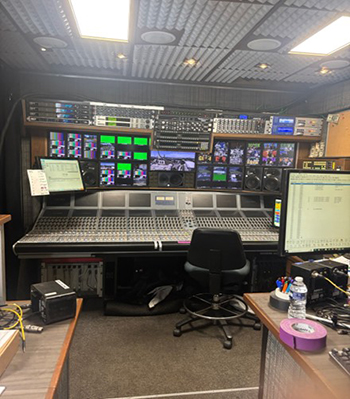 I was surprised to find that the production facilities operated on-site, handling both broadcasting and behind-the-scenes work in real-time.
While some preparation happens in advance, many communications decisions are made manually throughout the game. The strategic selection of statistics caught my attention.
During the home run derby, when one player hit only three home runs, the broadcast strategically displayed the leaderboard showing only the top four performers rather than highlighting the lower numbers.
I noticed that the communications during the broadcast would spotlight the best statistics and highlights rather than dwelling on poor performances.
This pattern of emphasizing positive achievements over less successful performances was consistent throughout the event.
References
Arth, Zachary W., and Andrew C. Billings. "Batting average and beyond: The framing of statistics within regional Major League Baseball broadcasts." International Journal of Sport Communication 14.2 (2021): 212-232.