

By Katie Voigt
Editor's Note: This is part 2 of a four-part mini-series discussing Pitt's annual Undergraduate Research and Creative Expression Fair.
Part 1 | Part 2 | Part 3 | Part 4
This past Tuesday, October 14th, I had the pleasure of attending and presenting an abstract at the Creative Expressions Fair. I created and presented a piece titled “What Does Responsible Use of AI in Communications Look Like for RDS@Pitt.” I had a couple of objectives in creating this work; one was to raise awareness for RDS@Pitt, and the other was to share a project related to communication efforts that use generative AI platforms to help sort and organize data points.
My abstract was an explanation of how AI can serve as a supportive tool in communication and marketing initiatives, rather than a replacement for human creativity and judgment. I discussed how generative AI can be used to identify patterns in research outputs, streamline content creation, and enhance storytelling while maintaining RDS@Pitt’s core values of authenticity, fairness, and ethical responsibility. Through this project, I aimed to demonstrate how responsible AI practices can make communication more effective and accessible, ultimately helping to expand the reach and impact of RDS@Pitt’s mission.
As part of my abstract, I included a QR code which linked to a google form titled, “What does Responsible Use of AI in Communications look like for RDS@Pitt?” The form asks a variety of questions all of which related to how we could improve the way we use generative AI responsibly at RDS@Pitt. 60% of the respondents were students, 10% were faculty, 10% had another role in higher education and 20% were none of the above. It is important to keep in mind that the majority of respondents were students.
When asked the first question, “Which of our values do you think are most important for us to consider as we develop our GenAI communication approach?” Out of the 5 values listed, 40% said responsibility, 30% of respondents selected Human-Centered and Contextual Awareness, 20% Transparency & Accountability, and 10% knowledge sharing. With responsibility being the majority, I think this means that we need to put a bigger emphasis on this value when designing and planning communication efforts for RDS@Pitt. The next question took a deeper dive into the question and in an open ended style asked “What other values should we be considering?” The responses were, privacy, trustworthiness, accuracy of information, Utility and vulnerability, fairness, and Promotion of using AI as a tool (not the only tool). From these responses, I think that privacy / confidentiality should definitely be added as another core value of RDS@Pitt.
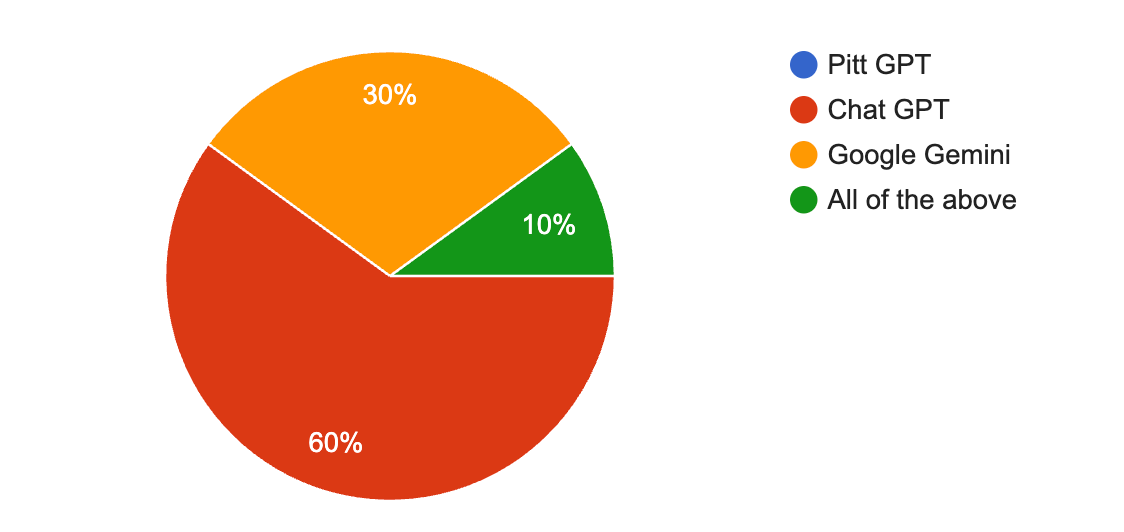
The next question asked, “What Platform of generative AI do you prefer?” While I wasn’t surprised to learn that the vast majority (60% of respondents) selected that they preferred ChatGPT, I hoped more would have selected Pitt GPT. An overall observation that I had during my time at the event was that many people asked me what PittGPT was and didn’t even know that the platform existed. I think that Pitt should promote this platform so that students know that it is acceptable to put personal information in as it already is present on the database through the platform. This could be used as not only a tool for students and faculty at the university, but it could be a step towards using generative AI more responsibly. It could prevent students from resorting to other platforms (such as ChatGPT) where it isn’t responsible to insert the personal information of faculty or students.
I had an incredible time learning about other students’ abstracts and I am so grateful for the opportunity to present my findings.